Friday, February 27, 2015
IMU Student Blogging Project to Promote a Healthy Lifestyle!
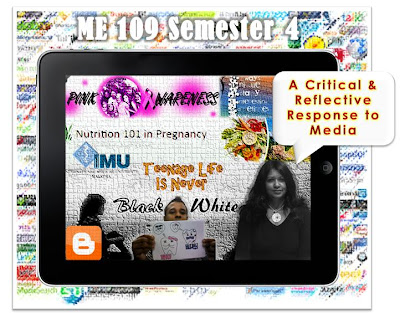
THE STORY
Of course that made me excited, as I have been promoting the usage of web 2.0 and social media for learning ever since I joined IMU (June 2009). And having already been through one cycle assisting Prof. Khoo Suan Phaik with her students project using Google Sites, I was quite confident it would be an inspiring and valuable learning experience.
A CRITICAL & REFLECTIVE RESPONSE TO MEDIA
This module facilitated by Sheba DMani focuses on connections between media and health within socio-cultural contexts. Media in the form of text and graphic presented through visual and audio modes from magazines, television and internet will be explored. These may include advertisements, films and music videos related to themes on health and healthcare. Students will approach these media texts through critical interpretation, reflective thinking and creative presentations. Upon completing this course, students will have learned that the media constructs views of the real world and that these views have been mediated to provide filtered and partial meaning of health belief and behaviour.
THE PROJECT & EVALUATION PROCESS
The blogs would be evaluated based on their originality and creativity (title, tag-line, content, etc.), and the blog had to include at least 3 articles/columns and/or editorials that convey messages on the chosen topic. Finally, each blog had to include at least one video or audio message developed by the group.
STUDENT LEARNING OUTPUT?
 "Healthy foods for a healthy baby"
The project team (Amelia, Melisa, Moushini, Natasha, Ray, Shahira, and Sharon) did a great collaborative effort. Congratulations!
In one word: Wonderful!
 "Teenage Life is Never Black & White"
 This blog focuses on adolescent issues aimed at the teenage population of 13-19. It explores in an emotionally creative, but informative way common youth challenges such as alcohol, drugs, relationships (family/friends/girlfriend/boyfriend), stress and smoking.
To really connect with the youth in an inspiring and engaging way, this hard working project team mashed-up their own original graphics, directed and recorded a short Abstinence Educational Video, set up a Facebook page, and used Xtranormal to create this cool animated video:
In one word: AWESOME!
 "BIG or small, We Save them All"
In one word: INSPIRING!
Understanding Asperger’s Syndrome
 This blog focuses on Aspergers Syndrome, which is often misunderstood among people. Aspergers Syndrome is an autism spectrum disorder that is characterized by significant difficulties in social interaction, along with restricted and repetitive patterns of behavior and interests. The project team has done a good job in designing and structuring the few (identified), but relevant issues regarding this disability, which include helping people to recognize it, statistics and epidemiology, books and resources, and famous people with it. Did you know that Albert Einstein had Aspergers Syndrome? Now you know!
In one word: INTERESTING!

In one word: CREATIVE!
Though, we still have to work on their fair use or reuse of external content and graphics, and teach them proper online referencing procedures, which is something we have to continue to work on. It is alright to quote and reuse (if permission is given), but we must appreciate and recognize other peoples work. As such we have already setup a site for IMU staff and students (only) exploring project based learning (in the e-learning portal), including proper online referencing procedures.
Although, our e-learning portal (using Moodle) is wonderful for uploading and organizing course content, linking online resources, online discussions, assignment submissions, online quizzes, and so on, we should also encourage and empower students to use other web 2.0 and social media tools for creating creative content and informal learning. For example, several lecturers from the School of Pharmacy use Facebook for communicating online with their students, and have experimented with conducting Problem-Based Learning (PBL) sessions using Facebook Groups.
I have noticed that some Universities in Malaysia ban the usage of Facebook and YouTube at their campuses, and use the excuse that they encourage poor learning/working habits and clog up their network (bandwidth) for other usages. That might be true, but if staff and students learn how to discipline themselves using such tools (no choice!), they will actually have access to some of the most amazing learning resources on the planet (for free), and be able to interact with experts and students from all over the world through Facebook groups/pages (e.g. Harvard University - Facebook). I cant think of a better investment for learning than boosting the network (bandwidth) to support online learning in all forms. The Internet is the heart, blood circulation, and oxygen of learning in the 21st century.
More importantly, today more than ever, it is critical to encourage students to nurture their communication, collaboration, creative and analytical skills using the web and multimedia tools. Increasingly in the future, people in organizations will be working and collaborating online using the cloud, so it is important to encourage and necessary to prepare our students for this new world.
Also, it is important to highlight here that the quality of the students output (results) at this stage is not as important as empowering their passionate and inquiring mindset to explore possibilities and ideas, and continuously reflect, learn and improve from these learning experiences. In short, focus more on the learning process than the output (results). Results will come as they learn. Some are early bloomers, others are late bloomers, and that is something we should never forget.
Can you imagine hiring a graduate that cannot communicate and collaborate online? Try asking that same question in four years time :)

Blogging With The Bosss Blessing By Michelle Conlin and Andrew Park
Link to article
"More companies are helping employees to speak freely -- and bond with customers "
"...In the past year, employee blogs have begun to multiply across Corporate America -- and a growing number of companies approve...Increasingly, execs see employee blogs as a way to transform a transaction with a faceless behemoth into a personal relationship with an employee. Blogs are also hyper efficient at driving product innovation. And they create loyal audiences.
...Microsoft has been one of the biggest evangelists. A year ago, it had about 100 corporate bloggers. Today there are 800. ..Indeed, Chairman William H. Gates III is so certain that corporate blogging is the next gold rush in communications that hes practically handing out the pails and shovels by enabling any employee to create a blog within two seconds. Microsoft doesnt train employees in the fine art of blogs, but employees hold meetings to talk about them...
...blogs can be dangerous, representing a new legal netherworld...Its likely only a matter of time before some workplace pundit spills a trade secret, unwittingly leaks a clandestine launch date, or takes a swipe at a CEO that turns into slander.For now, though, many are running the risk...blogs are becoming a kind of undercover megaphone. One way to think of them is as the latest guerrilla marketing tool, a new kind of brand bait."
Maybe we should have blog networks at Universities (including here) to improve communication and collaboration between (and among) Universities, faculties or departments, staff and students, which can also facilitate a relationship of understanding and appreciation. In addition, it can facilitate knowledge sharing of ideas from every corner of the University (or Universities), and enable a more enjoyable, innovative and creative learning environment.